Archive for the 'Growing Food' Category

Project: Mini Greenhouses for #SuperSowSunday

It’s finally here.  The day we have all been waiting for: #SuperSowSunday!  Last year a bunch of gardeners sowed our seeds on the same day as the Superbowl while tweeting about it.  It was a day of tip-sharing and silliness which marked the beginning of gardening season in an entertaining way.

This year the event has been expanded by Bren at BG Garden to be full of giveaways and experts to answer seed starting questions.  To follow join, just follow the instructions at  Super Sow Sunday.

Each year I start seeds indoors in heated seed trays with grow lights. I set up a big shelving unit, attach my lights and heating mats and plant label plant label plant label.

Since the last day of frost here is May 24th, it’s too early for many of the seeds I want to grow indoors (like tomatoes, peppers, and ground cherries).  Planting those now mean the seedlings will be leggy and overgrown by the time they are ready to plant.   Most I will start in April but I’ll do have early tomatoes and alpine strawberries to start in March. Stay tuned on those.

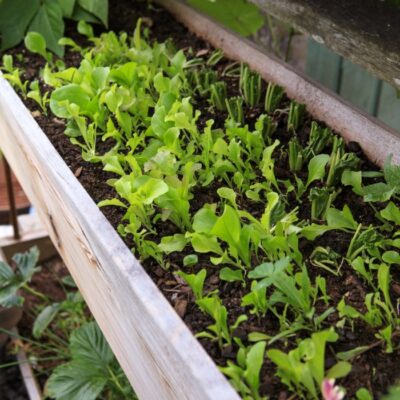
It is, however, the perfect time to start some cold-weather crops and get a jump start on spring veggies like salad greens and peas.  I plan to approach this the same way as last year given my outstanding success with it – planting in large outdoor containers under greenhouse umbrellas.

Project: Seed Starting with Mini Greenhouses

Find your Container

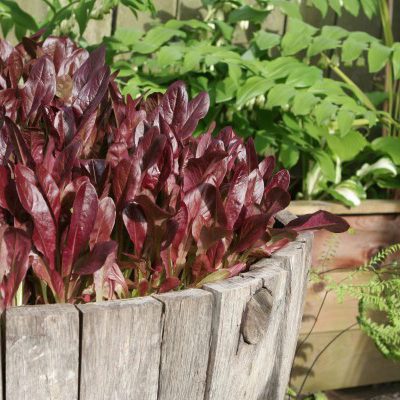
My climate conditions are chilly and wet in late winter, with a chance of snow/frost.  With this in mind, I chose large wooden containers like raised beds or wine barrel planters for my early seeds.  The moisture can move through the wood (meaning the soil can draw from the moisture in the air or release excess) and the large size of the container means the soil will stay warmer for the seedlings.

Prep the Soil

If you have a container with last year’s soil, turn it with a shovel or garden claw to fluff it up and mix from bottom to top.  Then dig in a layer of compost six inches below the surface of the soil to prepare some future nutrition for the seedlings as they grow up.  Finally cover the top layer of soil with a light, moisture-retaining material like seeding mix, peat moss, or coconut coir.  The little seeds will have the moisture they need to germinate and the soil will not develop a crust too hard for the seedlings to emerge from.

Plant Your Seeds

At this time of year germination rates tend to be lower so I plant densely.  Typically I will use a whole packet of lettuce seeds per wine barrel.  Growing time is much slower at this time of year and thinning is fun – baby salad greens are the first vegetables I get to eat from my garden so I plant many and eat many.  It ends up being very economical as well. From one packet of lettuce seeds I will thin and transplant lettuce all over the garden (and give lots away to friends) giving me a steady supply of salad from March through July.

Cover

I was lucky to find some great greenhouse covers at my local garden centres for pretty reasonable prices.  They have lasted me many years and I use them throughout each season from early frost protection of tomatoes to warming peppers and eggplants to covering my rosemary each time it snows.

Here are a few tips on what to look for when buying mini-greenhouses:

  • It doesn’t matter if it has a vent or not, generally you won’t use it.
  • Buy one with plastic or rust resistant parts – the ones that look the most like umbrellas have the same metal latching mechanism that an umbrella does and it undoubtedly will rust and become unusable in no time.
  • Greenhouses with a center stake are best (over the ones with pegs to hold down the edges).  You will lift the umbrella regularly to water, check the plants, and give them some air.  This will be frustrating if you have to find and reinsert the pegs each time.
  • The best greenhouses fold up for storage when not in use.
  • Update: because so many of you have asked where to buy one, here are similar versons that I found on Amazon.com: GreenThumb Pop-Up Greenhouse or FOLDING GREENHOUSE (P3IQ1094)

Venting and Watering

Managing the health of plants under mini greenhouses will be very much up to you as a gardener to decide what is needed.  Rain will not water your plants for you so this is now up to you to decide when to water.   If it is getting too moist or hot inside, you can lift the greenhouse slightly from the ground or know that it’s time to remove the greenhouse for good.

Hardening Off

When the seedlings have their first true leaves and the weather is starting to warm up, I tend to start hardening off my seedlings by removing the cover for a few hours each day, increasing the time slowly until they have a full day in the outside air uncovered.  I still cover the containers at night until my magical gardener’s sense tells me that they will be safe in the moonlight by themselves.

Thinning & Harvest

Om nom nom.  This is the most rewarding part: start cutting and eating the plants by snipping seedlings at the base with sharp scissors to make room for the other plants to grow bigger.  Baby lettuce, radishlings, and pea shoots are delightful in the spring.  Munch on snow peas in the garden while you plant other things and use them to get your dog to do tricks (my dog LOVES fresh peas).  And if you are like me you’ll have some many that you’ll schedule in a 10:30 salad each day just to keep up with it.

Share

February 06 2011 | Gardening and Growing Food and Projects | 10 Comments »

Choosing This Year’s Seeds

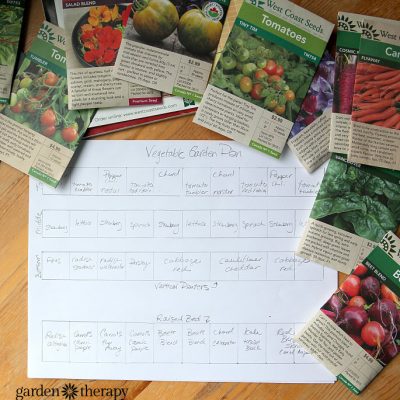
What seeds should I grow this year?  Hmmmm.  In true garden hoarder style I’ve collected way more seeds than I can every possibly plant in my tiny gardens.  Who can blame me!?  Seed companies send me catalogs all winter long.  And West Coast Seedshas the most delightful (and addictive) storefront in Ladner.  This outward brainwashing / mind-control has sucked up my free will sending me into zombie-like spending sprees.  I now have seed packets jumbled all over the place. 

I better get organized.

Me:  Little paper envelopes.  So pretty and so full of possibilities. What will you become if I plant you little seeds…

Reason: Stop that!! Get a yourself a CD organizer, create dividers out of cardboard, and file seeds by the month they should be planted.  Group them by type of seed (i.e.: all tomatoes together) and by like growing conditions (i.e.: tomatoes with peppers and basil).


Me: little paper dolls…

Reason: Snap out of it!  Get those packets organized and thinned out.

Me: <gasp!>

I don’t like thinning seedlings (Sophie’s Choice flashbacks) much less culling the planting options. But it must be done. I have a tiny urban garden not a farm <lost in dreaming of life someday on a farm>.  Ahem, yes, I can only plant so many seeds.  Let’s choose them.

In the last few years I grew about 100 different varieties of fruit, vegetables and herbs in my tiny urban gardens and my community garden plot.  This year I am paring that wayyyyy down.  I’ve given up the community garden plot  <sniff> and will be growing only the following (read: serious and strong tone):

Herbs:  

sweet basil, Thai basil, rosemary, sage, chives, parsley, cilantro.

Vegetables:

snap peas and snow peas, heirloom  tomatoes, French filet pole beans, giant garlic, hot peppers, rhubarb, salad greens.

Fruit:

blueberries, raspberries (red and gold), alpine strawberries, ground cherries, apples, plums.

Me:  But I want fennel and beets and carrots and squash! 

Reason: Sorry, no room.  Buy them at the farmers market. 

Me: Ugh.

So there we have it.  I have my plan for the year.  I’m just so absolutely certain that I won’t add another thing.  Well, maybe artichokes and kale in my flower beds if …clearly I have a problem.

Join us on Sunday February 6 for #SuperSowSunday where a bunch of crazy gardeners will be starting their annual seeds and tweeting about it thanks to Bren who’s organizing the shin-dig this year.

Share

February 03 2011 | Gardening and Growing Food and Projects | 7 Comments »

Comfort Food

In spring its asparagus, baby greens, and spring onions.  In summer and fall there is a cornucopia of colourful, fresh produce available to feed my nutritional desires.  Early winter its soups and roasted root vegetables that bring me comfort.  But in the New Year, when I’m depleted from the holidays and tired of excess, what brings me comfort is foods packed with nutrition to give me a much needed boost of energy.  Here are a few ways I add an extra punch to my diet:

Juice

Juicing is a great way to add a powerhouse of nutrition to your diet.  I enjoy a base of carrot, apple, and ginger to which you could add beets, celery, parsnip, pea shoots, orange, lemon, or cucumber.


Kefir

Kefir is a fermented milk drink full of beneficial yeast and friendly bacteria that will help keep your belly happy.  It’s also a source of Tryptophan (the amino acid found in turkey that calms the nervous system), phosphorus, B Vitamins and Vitamin K.  A bit of this in the morning sets me up for a good day.

Young Coconut Water

While I generally like to consume foods that are grown or raised nearby, you just can’t beat the electrolytes in young coconut water, considered nature’s Sports Drink.  Coconut water is an all natural isotonic beverage meaning it replaces the minerals and fluids lost when exercising.  I find this especially helpful in the winter when my body is working extra hard to fight off disease and keep warm.

Sprouts

Each sprout packs all the nutrition that the plant needs to grow into a full size cabbage or radish – so imagine how nutritious it is to eat a hundred of them at a time!  Sprouting is doesn’t have to be the same as it was back in the 1970’s.  I have an automatic sprouter that makes it super simple.

Micro Greens

Try seeding a package of your favourite peas, broccoli, radishes, etc in a small container with domed lid for mini plants that have the same benefits of sprouts.  I’ve been sprouting sunflower seeds in a biodegradable roast chicken dome.

I’m also currently investigating dairy-free kefir and manuka honey as I’ve heard such amazing things about both.  What comfort foods are you drawn to in the late winter?  Goji berries?  Raw cacao?  I’m always looking for new and exciting superfoods.

Share

January 12 2011 | Growing Food | 8 Comments »

Sprout, Avocado and Cream Cheese Sandwich

This past week I have been pretty heavy into the holiday parties yet I still made time to harvest my sprouts and make myself a decidedly summery sandwich: avocado, cream cheese and a mixture of lentil, radish, broccoli, red clover, and alfalfa sprouts.  This powerhouse of nutrition was just the thing to keep me whooping it up holiday style, and it makes a much healthier hangover meal!

Share

December 12 2010 | Growing Food and Harvest and Recipes | 10 Comments »

Harvesting Community Garden Roots

This week we thawed out from that crazy November snowfall and I jumped at the window of opportunity to dig up the rest of the root veggies from the community garden plot.   It was a very beautiful day at the garden.  Even though the plots are a mess I found it quite romantic with the setting sun beaming through the skeletons of  our summer gardens and sky-high pampas grass.


It felt great to get out and dig in the soil, and harvesting is always fun.  While I was disappointed to only have a few pounds of potatoes, I did get a bunch more Gladiator parsnips and a ton of various beets that I didn’t expect.  I roasted up this bunch of roots for a family dinner tonight.

Now that the community plot is officially put to bed for the winter I wonder weather I want to keep up the space again next year.  I have enough room to grow a small variety of veggies at home and while I love gardening with the community members, it has lately been feeling more like a chore.  Much of the food at the gardens gets stolen, many say because of the part of town we are in (notorious for homelessness and drugs) but sadly, the folks that I’ve seen steal are (gasp) other gardeners or visitors in suits who drive Hondas and show off their knowledge of growing food by cutting off all my garlic scapes or plucking a pumpkin.  Mostly the thieves are foodies with a sense of entitlement and little concern for community.  So that sucks.


Then there’s the growing conditions.  The soil is poor and disease is rampant.  Without daily weeding the plots are soon overrun with buttercup, horsetail, bindweed and in some cases the dangerous giant hogweed.  This year I just wanted to grow squash.  I ended up planting 10 types of squash and got about 12-15 orange spaghetti squash and downy mildrew killed the rest.  I did also plant strawberries, potatoes, artichokes, tomatoes, beans, celeriac, beets, parsnips, peas, fennel, carrots, garlic, leeks, and kale, so I strayed from my focus and got a little of everything (except the celeriac which was a big failure).  It’s fun to bring home fresh veggies and I haven’t really shopped for any in the grocery for the last 5-6 months.  The number and variety of what is left after theft and disease is just a taste.  Despite a valiant effort–I added manure to the soil, a bacterial / fungal mix that we bought at the farmers market and compost compost compost–the soil still lacked nutrition.  This combined with the fact that disease is so quickly spread in a community garden space that I fought rust, mildew and blight daily.  I certainly appreciate the fresh food I brought home, yet this alone is not worth the effort when I can buy the like at the farmers market each week.

Even if I never brought home a veggie I would still be a member because I joined the garden in the first place for the community.  I wanted to learn from others, connect and share.  In my mind perhaps I had the idea of a communal gardening group of people laughing and sharing huge baskets of fresh produce, while tending their lush green plots and beautifying the neighbourhood.  The reality is that you see most of the members only at the monthly work parties.  For most of the year I went to the work parties religiously.  A few of the other members have the same commitment, a few.  It’s great to see some of them, sometimes, but I wouldn’t call it a community.  There is rallying around the condom/needle clean up and stopping the crazy dude from pouring rat poison on our plants, but it’s not quite what I had imagined.  I’ve made a few friends at the garden though, so that’s something.

Now, as another year comes to a close I’ll reflect on whether or not it’s worth the effort or if perhaps there is another group or space that would be a better fit for me.  For all the reasons above I almost gave up my membership last year, but something kept me there.  The promise of something new, perhaps.  Maybe this year some new people with join and keep me company at the work parties.  Or perhaps I’ll get to run a seed starting project with the new greenhouse or learn something new.  Who knows?  But if I’ve learned just one thing about being a member of a community garden, it’s that it is about a whole lot more than just growing food.

Share

December 06 2010 | Gardening and Growing Food and Harvest and Vancouver | 13 Comments »

Harvesting…Snow?

I was just not prepared for snow.  Not in my garden, wardrobe, or attitude.  It’s not typical to get snow in Vancouver, particularly in November, so it’s reasonable to be unprepared.  The beet greens, parsnip tops, chard, kale, lettuce and all my winter vegetables got smooshed and frozen for a week.   And the trees weren’t prepared.  Leaves hadn’t fallen yet so the sticky white stuff brought down my 50-year old lilac and crushed a few other hardy growers.  One day it’s fall, then next, winter.  That’s just the way it is. 


I got out a few days before the dump and covered my rosemary, sage and gai lan with greenhouse umbrellas which may help a bit.  As you can see by the photos, it’s a bit like trying to drink a swimming pool. 

My weekly home-grown vegetable adventures weren’t a total bust though.  Just before the dump, I managed to get a few parsnips from the ground and make a lovely parsnip and white bean soup with crispy parsnips.  It was delish.


Now that the ground has thawed a bit I’ll try to dig up the potatoes I left at the community plot (whoops) and I pulled some beets.  Greens are wilty but the roots are plump and sweet.  I hope to continue pulling the roots for as long as I can, but I think that the winter vegetable starts are a write off for the year so I’ve set up the automatic sprouter indoors and I’ll grow my greens there for now.  

It’s been an interesting week or two we have been having here, so it’s great to have a look over at Daphne’s Dandelions to see what others are harvesting elsewhere.

Share

November 29 2010 | Growing Food and Harvest and Photography and Vancouver | 13 Comments »

Growing Sunflower Sprouts Indoors

Tis the season for micro greens and sprouts.   The weather outside is frightful freakin’ cold – the coldest on record in 25 years.  Too cold to sprout seeds outdoors, even under cover, so I’ve brought the operation indoors.

A few years ago I gleefully ripped open my festively-wrapped automatic sprouter and started the winter tradition of growing fresh greens on my kitchen table in the less pleasant months.   There are many seeds that benefit from spouting in this manner (hydroponically) like radish, alfalfa, lentil, clover, and many more.  Sunflowers however, do much better when grown as micro-greens: seeds that are sprouted in soil and harvested as seedlings.


Indoor Gardening Project: Sunflower Micro Greens

Equipment:

  • makeshift mini greenhouse
  • organic black oil sunflower seeds
  • clean potting soil

Directions:

No fancy equipment need for this high-brow salad trimming.  I used a biodegradable plastic dome (make sure it’s food safe) from a pre-cooked organic chicken: a prefect soil tray and greenhouse.  You could also use a milk jug cut in half, a cake tray, or whatever you can imagine that would create a mini greenhouse.


 Add about an inch of clean, rich soil to the bottom tray, and spread sunflower seeds over the top.  I generously cover the soil with seeds not letting any of them overlap.  Cover those seeds with just enough soil to hold moisture on them and put in a warm place out of direct sunlight.  The top of the fridge is a great place to sprout them.  In 1-4 days when the seeds have sprouted, remove the dome and get them to a bright windowsill.  Don’t bother using a grow light or worrying if the sun isn’t shining every day.  Who cares if they are leggy?!  You just get more yummy sprout to eat.


 The micro greens are ready to harvest when the mighty seedlings push up the soil (which helps to knock off the black husks) and grow two fat seed leaves.  Snip the seedlings at the base and wash in a salad spinner.  The nutty flavour is a fresh treat in the colder months and it only takes about 7 days from seed to table.


A great winter project for those days when you want to eat a salad and imagine yourself in Hawaii.

Share

November 22 2010 | Growing Food and Harvest and Projects | 20 Comments »

SodaStream Soda Maker Review

I happy to say that a few weeks ago I received a SodaStream Soda Maker to review.  It couldn’t have come at a better time as I had just made another batch of fruit cordial from fall’s bounty and I’d been buying bottles of soda like it was going out of style.  Truth be known, it IS going out of style.  People love their bubbles but not all the waste: cans, bottles, and flat soda are a drain on the environment and on our wallets. 

It was a wonderful treat to open the box and find a SodaStream Crystal – a sleek looking machine that makes up to 60 liters of sparkling water in beautiful glass carafes.  Within minutes of putting down the box cutter I had my first SodaStream soda.

How it Works:

Pretty simple.  Fill the carafe with water to the fill line.  Insert the carafe into the SodaStream and press the top button in short bursts until you hear a buzz.  I usually push the button until I hear 3 buzzes and this gives me wonderfully fizzy water. 


Review:

Taste  I was actually shocked at how good the sparkling water tasted.  I expected club soda which tastes fine but it’s meant to have something added to it.  SodaStream sparkling water doesn’t need anything added!  It has a crisp bite and a fresh flavour that is delightful on its own.  I’ve tried it with both tap water and spring water and the results are equally as strong (we do have great tap water here in Vancouver).

Soda  I like that you can add as much carbonation as you can handle.  I add 3 pumps for sparkling water straight up, and 6 pumps for soda with added juice or syrup.  Here’s a tip though, add the soda to your glass first, then add the juice or you will get a volcanic explosion of fizz.

Machine  The unit is made from plastic mostly and is quite tall (on the countertop it just clears standard height upper cabinets) but it is very thin so it takes up little room if you want to tuck it away.  I keep it on my counter right near my spring water dispenser so it’s easy to whip up soda in seconds.  The plastic casing is lightweight but can be a little rickety.  When I pump the button the casing will pop right off, so I need to hold the unit down with one hand so that it doesn’t come apart and a couple of times it has malfunctioned (my fault maybe?) in that water exploded in the machine on the first pump.    

Carafes  Included with the crystals are two glass carafes.  Each carafe holds 620ml (about 2 cans of soda) and comes with a fizz-preserving closure which I’ve had mixed reviews with.  Sometimes I put a half-full (or half-empty if you are a cynic) in the fridge and find it flat a day later.  Other times it still has some fizz after a few days.  I’m not sure why the variation but I’m sure I’ll figure it out in time.

Worth the price?  Given the price of the starter kit I wasn’t sure I would have bought a SodaStream for myself (it would’ve been a great Christmas gift though), but now that I have used it, served friends, and invented all sorts of recipes, I’m sold!  I think if you drink a lot of soda, want a healthier option, and want to reduce waste, then it is definitely worth the start up price.  Like many gadgets, I can’t imagine going back to the olden days of lugging heavy packs of bottles home and recycling, recycling, recycling.

Soda Stream vs. Soda Siphon:

When I was first thinking of getting a home soda maker, I questioned whether the old fashioned soda siphons (think Italian Soda) would be a good option.  This is the lower cost alternative to the SodaStream out there on the market however the soda siphons require a new CO2 cartridge for every liter of soda.  Here is a comparison:

  Soda Siphon SodaStream Perrier 1L bottles
starter kit $44.00 to $89.00 USD $99.99 – $249.99 CAD $79.95 – $199.95 USD  $0
CO2 cost per first 60 L of soda $60.00 for 60 CO2 plugs + shipping costs Included in starter kit prices vary so approx. $90.00 (at $1.50/L)
CO2 cost per additional 60 L of soda $60.00 for 60 CO2 plugs + shipping costs $19.99 for canister refills for 60L + shipping costs ~ $90.00
carbon expense / waste per 60L 60 empty CO2 plugs shipping (if necessary) 60 empty bottles


Mixology

Now comes the fun part.  For the creative barkeep, chef or foodie there is no limitation to the flavors you can amplify with bubbles on the tongue.  At your next cocktail party, try serving preserved fruit or pickles in an equal mix of sparkling water and canning liquid.  When my amaretto figs are ready in a month, I plan to serve them this way – with some bite! 

If bubbles in your drinks is more your style, below are a few recipes that are part of my fizzy drink repertoire.  (There are also some great recipes here submitted by SodaStream fans.) 

1. Make natural soda by mixing one of these flavoured cordials or syrups to sparking water – a refreshing change from cola.

2. Forget chemically flavored water, there are plenty of ingredients in your garden and fridge that’ll make delightfully unique flavoured water.  Most brands don’t use real anything in their flavouring so be wary of even the gourmet lemon or lime waters.  Try these instead:

  • Squeeze of lemon, lime, orange, or grapefruit
  • Sliced cucumbers, beets, or celery
  • Herbs like basil, thyme, mint, lemon balm, vanilla bean and cinnamon stick.  Try interesting herbs like thai basil or chocolate mint and sweeten with a drop of stevia.
  • Floating fruit like cranberries, strawberries, blueberries  – these add no flavour but make wonderful garnishes.

3. If, like me, the cocktails in Bon Appetite magazine have you excited to try thier alcoholic concoctions, then raid the liquor cabinet for cocktail ingredients and make ‘em fizzy. 


The Final Word

Overall, after testing it out for a few weeks, I would definitely buy a SodaStream.  I probably wouldn’t invest in the glass carafe “Crystal” machine at $239.99, instead opting for the less expensive and functionally the same “Jet White” for $99.00.  Although I must admit I do love having glass bottles as I use very little plastic at home to store food.  Whichever one you choose, the SodaStream is economical, environmentally-friendly, healthy, and fun.  Plus, you get to plan for new recipes.  Next on my “To Make” list: blueberry infused vodka, pear syrup, and limoncello to mix with my ohsofizzybubblingsparkling water.

*Note: prices are in Canadian dollars, US prices are a bit cheaper.  Check them out here:

Share

November 19 2010 | Growing Food and Projects and Recipes | 12 Comments »

Where My Eggs Come From

Share

November 16 2010 | Growing Food and Harvest and Vancouver | 10 Comments »

Harvest Report for November

I’m proud to say that my shiitake mushroom block is back to work producing mushrooms again.  I bought this block last year at the Van Dusen Plant Sale and kept it under my deck for the spring where it gave me many meals.  As summer hit it became too warm for the block to be outside and the mushrooms were mushy (ironically bad), so I harvested what was left and put the sucker to bed in the back of the fridge.  I pulled it out again a few weeks ago and in no time I had a number of huge mushrooms bursting from the bag. 


These three shiitakes made a heathy serving for 2 after being sauteed in some butter and salt.  Amazing!  They were buttery, meaty, and by far the very best mushrooms I have ever had.  If you get the chance to try growing your own, do it!  You’ll be rewarded with a whole new appreciation for mushrooms.


As for the rest of the garden, I’m shocked at number of edibles that are still growing in my garden despite the wet, sunless days and cold temps.  I’m still eating tomatoes (even if I did pick them a few weeks ago), beets, kale, chard, and of course lots and lots of herbs.  Since it’s the season for soups and stews, a huge handful or rosemary, sage and oregano goes into just about everything I simmer or bake.  I’ve also had a nice resurgence of my Kentucky Colonel mint (THE mint for a mint julep or mojito) and a whole bunch of stevia that I’m not totally sure what to do with.

I picked the last of a few things this week: Thai Dragon, Habanero, Garden Salsa, and Filius Blue peppers – although pretty they aren’t very hot.  Peppers really need heat to build their spiciness, and October/November just ain’t going to give us the spice in Vancouver.


I also harvested the rest of the ground cherries.  Many are still green, some are split from the cold, but there are lots of them and many are big.  I plan to pick through the bunch (and toss the green ones which are rumored to be toxic) and whip up the amazing Ground Cherry Caramel I made last year.  Damn that was good stuff.


There is some nice growth on my winter crops – well, at least the ones that didn’t get mowed by slugs!  Daikon radish, Altaglobe radish, winter turnip, spinach, mizuna, and Gai Lan (Chinese broccoli) are all doing very well.  M y lettuce seedlings have pretty much been more trouble than they are worth, so I do hope that in a few months I might actually get a salad, but if the weather doesn’t cooperate it isn’t looking good.  Boy do I hate store-bought salad.  I’m going to fire up the automatic spouter again this week and get me some fresh greens inside if I can’t get ‘em outside.

That’s my harvest report for this time of year.  I look forward to hearing and reading all about what’s happening at your gardens all around the globe.

Share

November 07 2010 | Growing Food and Harvest and Projects | 16 Comments »

« Prev - Next »