Whole Wheat Blueberry Lemon Scone Recipe

Continuing with this month’s Citrus Celebration theme, this morning we made the flakiest whole wheat blueberry lemon scones for breakfast.  With a perfectly balanced aroma of lemon, sweet blueberries, and buttery goodness, these are hands-down my favourite scones.  The scone is shown here with Meyer Lemon Marmalade that was made earlier this week (stay tuned for the recipe).  In the meantime, try them with this Blood Orange and Raspberry Jam.

Whole Wheat Blueberry Lemon Scone recipe with meyer lemon jam

   Ingredients:

  • 2 cups all purpose flour
  • 2 cups whole wheat flour
  • 1/4 cup sugar
  • 2 tsp baking powder
  • 1/2  tsp baking soda
  • 1 cup (2 sticks) butter, very cold and cut into cubes
  • 1 cup frozen blueberries
  • Zest of 2 organic lemons
  • 1 cup milk
  • 1/3 cup cream
  • Juice of 2 organic lemons
  • 1 tsp vanilla

Directions:

Preheat oven to 400°F and line a baking pan with parchment and sprinkle it with flour. Measure out and combine the milk, cream, lemon juice and vanilla. Stir and let sit while you measure the dry ingredients, it will become thick and a bit separated – that’s OK!  Combine the dry ingredients in a large bowl.  Add the butter and gently cut the butter in using a pastry knife until it is somewhat mixed in and chunks of butter are still visible.  More butter chunks = flakier scone.   Add lemon zest and milk mixture to the flour mix and gently combine.  Gently fold in frozen blueberries.  Pour dough out onto a floured surface and very lightly knead only about 5 times being careful not to melt the butter or blueberries. Dough will not be completely mixed, but if it feels equally moist all around, and not overly sticky, it’s ready to shape.

Shape the dough into 2 equal balls and flatten to 3/4″ thick on the floured parchment or pan.  Using a knife slice each circle into 6 wedges and carefully pull the wedges away from the center to separate them to 1/2″ space around the outer edges.   Bake until golden about 20 minutes, or until a tester comes out clean when inserted in the middle.

Makes 12 extra large scones


Share

Blood Orange and Raspberry Jam Recipe

Some things seem to be drawn together organically, like the flavors of blood orange and raspberry.  It’s citrus season here now – the only time of the year blood oranges are available. Since raspberries are abundant in late summer this jam recipe has been in progress for 6 months.  Despite having very different seasons the tie between these two fruits is undeniable. When I first tasted the blood orange juice it was kind of, well, blah.  Not as sweet and vibrant as an orange, albeit the juice is beautifully rich to look at the flavor lacks punch.  But what I did taste was a slight hint, a murmur maybe, of  raspberry.  It was immediate and undeniable that these two fruits must go together.  Hence this blood orange and raspberry jam recipe was born.

First made last winter, the jars were quickly gobbled up as it is my all-time-favorite jam of all time.  Then in the summer when raspberries were ripe and ready, I hunted for blood oranges.  In this day and age of abundance I though someone might stock a few.  Nope.  I settled for making the recipe with cape gooseberries and it was good.  Just not my all-time-favorite of all time.

But now it’s time, my friends, time for blood orange and raspberry jam.  Finally.  Here is the recipe:


Ingredients:

  • enough  blood oranges to get 4 cups freshly-squeezed juice
  • 4 cups raspberries
  • 3-4 cups sugar (this really depends on your preferences and how sweet the fruit is) I used 3 cups and my jam is perfectly sweet and tart
  • cheesecloth

Directions: 

  • Put a couple of plates in the freezer.
  • Juice those bloody oranges until you get 4 cups.  Take all the membrane and seeds out of the peels and tie into a square of cheesecloth (I used a 4-ply thickness of cheesecloth, i.e. a large square folded in half twice).  Tie the ends of the cheesecloth around a large wooded spoon.  This is your pectin bag.
  • Add juice to a large pot with the raspberries and sugar and bring to a boil on medium-high.  Stir frequently.  Hang bag of orange guts from the edge of the pot.  I rigged up something with a chopstick and a clip on the side of the pot, but the large wooden spoon works great too.
  • When boiling, reduce heat to medium-low and continue boiling and stirring until reduced.   Remove pectin bag and let cool.  When cool enough to handle, squeeze the bag so that a creamy gel comes out of the pores of the cheesecloth – that’s your pectin!  Scrape the pectin back into the jam and stir.  Then you can discard the bag and membranes.
  • Jam is ready when it passes the gel test: put a spoonful of the jam on a plate from the freezer.  When the jam has cooled, drag your finger through the middle of the glob.  If it spreads back into a puddle, it isn’t gelled yet.  If your finger mark stays put, then your jam is ready to be canned.
  • Process 125ml (aka 1/2 cup) jars for 5 minutes, or 250ml (aka 1 cup jars) for 10 minutes in a boiling water canner.


In other news, just as these flavors came together organically, it seems that right at the same time I’m all ramped up about citrus, I have a few new Garden Therapy Handmade pillows to launch.  This one seemed particularly fitting to announce today, given the citrus-y color of the crocosmia blooms.  For those of you who haven’t yet, please visit the Garden Therapy Handmade shop and take a look at all the bright-colored blooms.  Hopefully they will bring some cheer to your winter’s days.

Share

Preserved Lemons Recipe

If you haven’t yet tried preserved lemons, now is the time.  Primarily used in Moroccan cooking, this unique salty citrus flavour quickly makes an amazing dish out of chicken or fish and adds lift to sautéed vegetables or beans.  This recipe has only two ingredients, so choose them wisely.  Organic lemons are the only ones I ever use for preserving as the rind will have less junk (pesticides, etc.) on it.

Ingredients: 

  • 12 organic lemons
  • coarse Kosher salt

Directions:

1. Scrub the lemons under running water with a vegetable or nail brush to get the rind nice and clean.  Then cut the stems and ends off the lemons.

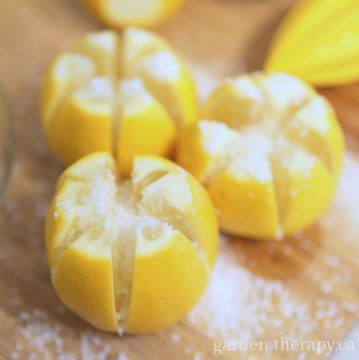
2. Score each lemon into a star: start by making a cut through the lemon from the top down to almost the bottom, but don’t slice all the way through.  Leave enough remaining so that the lemon stays attached.  Cut again twice more, to get a star shape.

3. Pack the insides of the star with lots of coarse salt.  Don’t be afraid of the salt it’s not going to become overly salty if you use too much.  Just go for it!

4. Now pack the lemons into clean, sterilized jars.  Really squish them in there so that the juices start to cover the lemons.  Add extra fresh lemon juice if you need to top each jar up so that all the  lemons are completely covered.  Keep squishing down the lemons over the next couple of days to get more juices out and covering the fruit.

5. Let sit for a month in a cold place like the fridge until the rinds soften.

To use the preserved lemons, rinse under cold running water and remove the pulp.  The pulp can be squeezed for it’s juice, but generally the rind is what is used.  Slice or dice the rind to add to recipes like this one: Chicken Tagine with Green Olives and Preserved Lemon. Yum!


Share
2012 (c) Copyright Garden Therapy