Blood Orange and Raspberry Jam Recipe

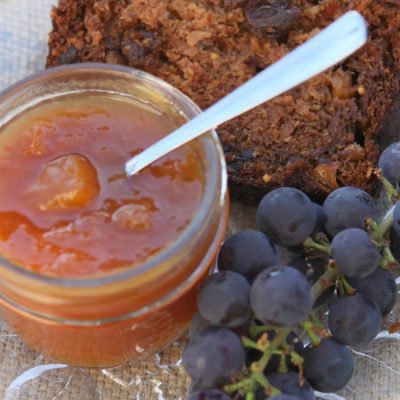
Some things seem to be drawn together organically, like the flavors of blood orange and raspberry.  It’s citrus season here now – the only time of the year blood oranges are available. Since raspberries are abundant in late summer this jam recipe has been in progress for 6 months.  Despite having very different seasons the tie between these two fruits is undeniable. When I first tasted the blood orange juice it was kind of, well, blah.  Not as sweet and vibrant as an orange, albeit the juice is beautifully rich to look at the flavor lacks punch.  But what I did taste was a slight hint, a murmur maybe, of  raspberry.  It was immediate and undeniable that these two fruits must go together.  Hence this blood orange and raspberry jam recipe was born.

First made last winter, the jars were quickly gobbled up as it is my all-time-favorite jam of all time.  Then in the summer when raspberries were ripe and ready, I hunted for blood oranges.  In this day and age of abundance I though someone might stock a few.  Nope.  I settled for making the recipe with cape gooseberries and it was good.  Just not my all-time-favorite of all time.

But now it’s time, my friends, time for blood orange and raspberry jam.  Finally.  Here is the recipe:


Ingredients:

  • enough  blood oranges to get 4 cups freshly-squeezed juice
  • 4 cups raspberries
  • 3-4 cups sugar (this really depends on your preferences and how sweet the fruit is) I used 3 cups and my jam is perfectly sweet and tart
  • cheesecloth

Directions: 

  • Put a couple of plates in the freezer.
  • Juice those bloody oranges until you get 4 cups.  Take all the membrane and seeds out of the peels and tie into a square of cheesecloth (I used a 4-ply thickness of cheesecloth, i.e. a large square folded in half twice).  Tie the ends of the cheesecloth around a large wooded spoon.  This is your pectin bag.
  • Add juice to a large pot with the raspberries and sugar and bring to a boil on medium-high.  Stir frequently.  Hang bag of orange guts from the edge of the pot.  I rigged up something with a chopstick and a clip on the side of the pot, but the large wooden spoon works great too.
  • When boiling, reduce heat to medium-low and continue boiling and stirring until reduced.   Remove pectin bag and let cool.  When cool enough to handle, squeeze the bag so that a creamy gel comes out of the pores of the cheesecloth – that’s your pectin!  Scrape the pectin back into the jam and stir.  Then you can discard the bag and membranes.
  • Jam is ready when it passes the gel test: put a spoonful of the jam on a plate from the freezer.  When the jam has cooled, drag your finger through the middle of the glob.  If it spreads back into a puddle, it isn’t gelled yet.  If your finger mark stays put, then your jam is ready to be canned.
  • Process 125ml (aka 1/2 cup) jars for 5 minutes, or 250ml (aka 1 cup jars) for 10 minutes in a boiling water canner.


In other news, just as these flavors came together organically, it seems that right at the same time I’m all ramped up about citrus, I have a few new Garden Therapy Handmade pillows to launch.  This one seemed particularly fitting to announce today, given the citrus-y color of the crocosmia blooms.  For those of you who haven’t yet, please visit the Garden Therapy Handmade shop and take a look at all the bright-colored blooms.  Hopefully they will bring some cheer to your winter’s days.

Share

Preserved Lemons Recipe

If you haven’t yet tried preserved lemons, now is the time.  Primarily used in Moroccan cooking, this unique salty citrus flavour quickly makes an amazing dish out of chicken or fish and adds lift to sautéed vegetables or beans.  This recipe has only two ingredients, so choose them wisely.  Organic lemons are the only ones I ever use for preserving as the rind will have less junk (pesticides, etc.) on it.

Ingredients: 

  • 12 organic lemons
  • coarse Kosher salt

Directions:

1. Scrub the lemons under running water with a vegetable or nail brush to get the rind nice and clean.  Then cut the stems and ends off the lemons.

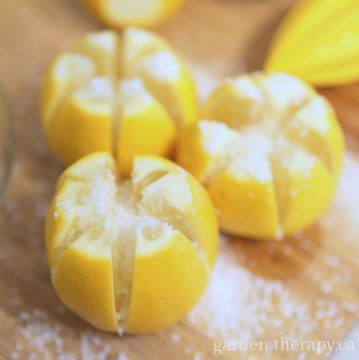
2. Score each lemon into a star: start by making a cut through the lemon from the top down to almost the bottom, but don’t slice all the way through.  Leave enough remaining so that the lemon stays attached.  Cut again twice more, to get a star shape.

3. Pack the insides of the star with lots of coarse salt.  Don’t be afraid of the salt it’s not going to become overly salty if you use too much.  Just go for it!

4. Now pack the lemons into clean, sterilized jars.  Really squish them in there so that the juices start to cover the lemons.  Add extra fresh lemon juice if you need to top each jar up so that all the  lemons are completely covered.  Keep squishing down the lemons over the next couple of days to get more juices out and covering the fruit.

5. Let sit for a month in a cold place like the fridge until the rinds soften.

To use the preserved lemons, rinse under cold running water and remove the pulp.  The pulp can be squeezed for it’s juice, but generally the rind is what is used.  Slice or dice the rind to add to recipes like this one: Chicken Tagine with Green Olives and Preserved Lemon. Yum!


Share

Homemade Bourbon Cranberry Sauce Recipe

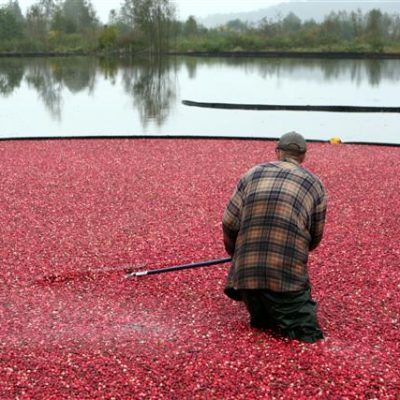
Did you know that British Columbia is the 3rd largest producer of cranberries worldwide?  BC produces about 17 million kilograms of cranberries annually on about 50 family farm operations.  Just a short drive away from Vancouver there are cranberry bogs that you can check out.  They are just beautiful in mid-autumn when the bogs are flooded and all the ripe cranberries float to the top of the bog, get corralled in, and are harvested.  Each year we head down to Fort Langley and buy bags of cranberries straight from the farm.  They freeze well and are a delicious addition to baking and savoury cooking alike.

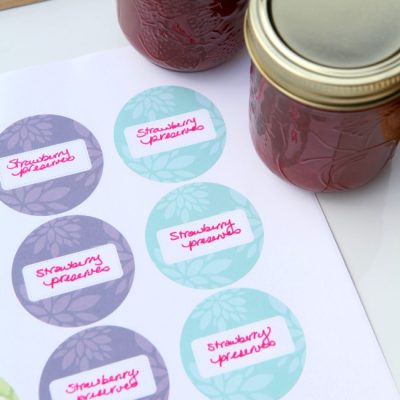
With American Thanksgiving coming up this week, I thought I’d share my homemade bourbon cranberry sauce recipe.  We gave jars of this away to each of the guests that joined us for Canadian thanksgiving back in October.  The recipe is intended for canning so you (and your guests if they are lucky enough to take a jar home) can store in the cupboard until Christmas or Thanksgiving next year.  Don’t forget to dress up your jars with some adorable canning labels you can download and print on label paper.  Here is a custom design for this recipe:  Garden Therapy Bourbon Cranberry Sauce Labels.

Ingredients:

  • 6  cups cranberries
  • 1 1/2 cups sugar
  • 1/2 cup water
  • 1 tbsp red wine vinegar
  • 1/2 cup bourbon
Directions:
  1. Combine sugar, water, and vinegar in a tall-sided saucepan and bring to a boil over high heat.
  2. Stir until the sugar is dissolved, then add cranberries.
  3. Return to a boil, then reduce heat and stir rapidly uncovered for 5 minutes until cranberries burst.
  4. Stir in bourbon.
  5. Ladle into hot jars leaving 1/2″ of headspace.  Process in a boiling water canner for 15 minutes for 250ml (1 cup) jars.

Makes three 250ml (half pint) jars or six 125ml jars.

We’re participating in these linky parties or blog hops.

Share

Freebie: Brand-Spanking-New Canning Labels


Since many of us out there are elbows-deep preserving the late summer bounty into jams, jellies, pickles, and sauce, we thought it would be a good time to create some new canning label templates you can download and print for free.  Ta da!

Templates:

Supplies:

  • Full page shipping labels or heavy-stock, glossy paper and spray adhesive
  • Colour laser printer
  • 2″ and/or 2.5″ round hole punch or scissors


Steps:

1.  Print the labels on a full sheet shipping label or on a nice heavy-stock, glossy paper.  Buy the best quality shipping label you can find.  We like glossy paper for these.  Printing can be done on your colour laser printer at home (do not use an ink jet printer as that will smudge when wet) or by taking the file to a printing house.

2. Use a 2″ or a 2.5″ hole punch (available at craft stores or online) to cut out each label or if you don’t want to invest in one of those fancy tools, cut by hand with sharp scissors.

3. If using plain paper, cover the back of each label with spray adhesive according to directions on the can, or use another type of fairly dry glue (don’t use white glue or the label with pucker).

4. Apply the labels to your homemade creations and revel in the beauty you have brought to the world.


For more ideas on how to dress up your canning creations, check out last year’s canning label template project and canning label inspiration contest.

Share

Black and Blue Berry Jam Recipe

I just can’t stop eating the scrumptious blackberry and blueberry I made this past weekend.  I guess I shouldn’t be surprised that it tastes this good, I mean these two fruits were obviously meant to go together: they grew only steps from each other.

When went for my annual wild blackberry picking pilgrimage, I stopped off at my favorite organic blueberry farm on the way back.  It never crossed my mind until this year that the sweet blueberries and the tart blackberries would be an amazing compliment to each other.  So good I have to share:

Black and Blue Berry Jam (long boil a.k.a. no pectin)

  • 4 cups blackberries
  • 4 cups blueberries
  • 5 cups sugar (just a guideline, adjust to your own tastes)
  • 2-3 tbsp lemon juice

Add all ingredients to a large, tall pot and set on medium high. Stir constantly until juices release and the mixture is soupy and boiling. Reduce to medium low and keep boiling, stirring occasionally, and using the spoon or a potato masher to squish the berries. Put a few small plates in the freezer. Continue boiling and stirring jam until mixture starts to thicken and foam subsides. Check jam for consistency by putting a spoonful of jam on one of the chilled plates.  When the mixture cools, ask yourself: ”Do I like this consistency?”  Keep boiling jam and testing until you answer, “Yes!”  then ladle  into clean, sterilized 250ml (1 cup) jars.  Process in a boiling water canner for 15 minutes with adjustments for your area.  Store for up to a year in a cool, dark place.

Share

It’s Canning Season

It’s that time of year again that keeps my hands and my senses overloaded.  I hoard fresh produce when I see it at a market or farm, or by climbing my neighbour’s trees like a squirrel and collecting way to0 many figs, or by diving deep into the wild blackberry brambles for fresh blackberries.  I can’t help it.  It’s a compulsion.

Here are a few photos of the harvesting frenzy for the last full week of August.  How can you blame me for stocking up?

Figs are abundant again on my neighbours tree although not as much as they were last year.  I made balsamic, fig, & rosemary preserves, dried figs in my dehydrator, and plan to make whole figs in a balsamic syrup.

I picked up pickling cukes at a farm this year for the first time and they are pickling away in my dining room.


My secret blackberry picking spot was loaded this year so I made blackberry pie, blackberry jam, blackberry & blueberry jam, and froze some for baking and ice cream.


The tomatoes are staring to come in as well, some of which have seen dehydrated, others made into sauce for the winter.


Any other squirrels out there stocking up for the winter?

Share

Project: Winter Marmalade

There is a very small window here in the winter to find the sour Seville oranges that are used make marmalade.  But since a traditional English marmalade is not considered a West Coast staple, I’d never tasted it before attempting to make it.  I did, however, have a few things going in my favour: I can make a mean jam after honing my skills on 19 jams in the past 3 years, I found some Seville oranges, and I like store-bought marmalade. 

I read that traditional Seville orange marmalade was first made by a grocer who hastily purchased a large number of oranges from a Spanish farmer.  When she did take the time to taste them, they were so sour and full of seeds they would not be sellable.  Not wanting to waste the lot, she made the first Seville orange marmalade.   

Just the fact that Seville oranges are rare and seasonal peaked my interest, but the “making lemonade from lemons” was enough to send me running to the grocery store to buy supplies. 


Sadly, not everyone gets lemonade, or in my case a delicious, citrusy spread.  Sometimes you spend 6 hours peeling, juicing, seeding, cooking and canning marmalade and get crap.  Jam #20 was a huge failure for one reason: I left too much pith (the white rind between the peel and the flesh of the fruit) on my peels and the whole batch (14 jars) was terribly bitter.  Unfortunately the recipe said, “pith is bitter, so the more you can get out the better. But don’t worry if you can’t get it all out.”  I took this to heart and unfortunately that was the wrong call for my palette so that’s 14 jars of pithy junk down the sink.


Not one to back down from a challenge, I set out to kick some marmalade ass (and do it my way, no offence to 18th century English grocers).  So I bought some tangelos, Meyer lemons, lemons, limes, and pink grapefruit and made a much more modern Five Fruit Marmalade. The colour is delightfully orange, the consistency is more jelly than rind, and the flavour is the right balance of sweet-tart-bitter-bright.  It tastes amazing on a scone and guess what?  You can make it anytime you want!  Plus it tastes amazing on chicken as in this recipe I made last night.


While not every recipe turns out to be perfect, I’m happy to say that I have now put 2 more jams under my belt (um, literally) and I think the bitter jam only served to make the sweet jam more appealing.  Perhaps next winter I’ll take another run at traditional Seville orange marmalade, but certainly in a much, much smaller batch.


Share

Canning Label Inspiration Contest Winner!

The winner for the Canning Label Inspiration Contest is Katherine from Kitten’s Lost Her Mittens as chosen by the random number generator.   Thanks to everyone who participated by sharing very creative ways to add a little extra to homemade goodies.  Here is the winning entry.  Who wouldn’t want to get this as a holiday gift?


Share

Project: Homemade Canning Labels for Jam, Pickles and More

UPDATE: We’ve added 6 new printable canning label templates!  Enjoy!

After spending hours making the perfectly crafted homemade jam, jelly, chutney or pickle, I get on to making the perfect label to gussy up my jars.  Like wrapping a present or dressing for dinner, accessorizing with labels can really add to the finished product.  What’s inside the jar is art: beautiful flavours and colours and freshness packed lovingly into a tiny glass container.  Why not accessorize?  It will make a perfect holiday gift.

Supplies:

  • Full page shipping labels
  • Computer with graphics program (or even MS Word will work)
  • Colour laser printer
  • 2″ and/or 2.5″ round hole punch or scissors

Steps:

1. First, draw a circle in your graphics program on the computer to be the size of the label you want to put on the top of the jar.  For instance, I made a 2″ circle for a regular mouth (78mm) lid and a 2.5″ circle for wide mouth (80mm) lid.  Then add photos, graphics, and text to design your label.  I like to use photos I’ve taken of the ingrredients when they are growing in the garden or freshly harvested but you could use any graphic that appeals to you, the preserve or the season.  For those who prefer the kitchen to the computer, I’ve created some simple templates:

2.  When you are happy with your design, print the labels on a full sheet shipping label that can be purchased from any office supply store.  Buy the best quality shipping label you can find.  I like glossy paper for these.  Printing can be done on your colour laser printer at home (do not use an ink jet printer as that will smudge when wet) or by taking the file to a printing house.

3. Use a 2″ or a 2.5″ hole punch (available at craft stores) to cut out each label or if you don’t want to invest in one of those fancy tools, cut by hand with sharp scissors.  Thanks to Andrew for the fabulous hole punch idea as it made it sooooo much easier.

4. Apply the labels to your homemade creations and revel in the beauty you have brought to the world.

Looking for more inspiration?  Check out the Canning Label Inspiration page and contest.  Enter your finished project by December 15th to participate in the contest.

Share

Delish Fall Issue: Preserving Summer

If you haven’t seen the Fall issue of Delish yet…what are you waiting for?!  It’s fall, it’s free to reader, and it’s a pretty fantastic read.  

I have a few pieces running this season, but since I’ve been posting about preserving lately, I thought I’d post a taste here.  For the full article with recipes and handy links, check out Delish.  Oh, and if you make your own creative canning labels, check out my Jam Label Inspiration Contest.

PRESERVING SUMMER

www.delishmag.com Fall 2010 Issue: Change

Gardeners know what a tomato is. And it’s not the geneticallymodifiedmushyblandwateryshippedfromfarfaraway tomato that can be found in grocery stores. It can be perfectly round, or bulbous and odd looking. Red, orange, yellow, green, pink, purple black, or all of the above. Grape-shaped, cherry-shaped, strawberry-shaped, lemon-shaped, egg-shaped, or whattheheckisthatshape-shaped. A garden tomato can be meaty and sweet, with such a big punch of flavor that you can easily chop a bit up and add it to eggs or sautéed veggies to brighten up the flavor. Or it can be a cheery cherry tomato treat still warm from the sun that bursts in your mouth as you garden. Some are lemony, tart, sugary, earthy, salty, buttery, but never, never the blah of the non-garden variety grocery store tomato.


With all this variety it’s no wonder we gardeners wait all year for fresh garden delights to be in season. We plan out our seed lists in the chilly winter, start our prized seeds in heated trays and grow lights while still under frost, watch the temperatures rise in the spring until that magical day of last frost that the seedlings can be set out on their own in the garden. We spend the summer pruning, staking, watering, and nursing our leafy babies, praising their flower buds and watching the fruit grow bigger week after week. Until one day in the heat of summer, when we can’t wait even another day, there it is: the first tomato.

Finally!

The recipes that swirl around in our heads fall victim to our primal urge and we just gobble it up right there in the garden. Luckily, before long there is another and another and another of those prized globes. In summer and fall, garden goodies will ripen faster than you can get your harvest basket out and soon your friends and family are overflowing with your bounty as well.

Amidst the lavish cornucopia of fresh foods available during fall harvest, it’s difficult to remember days spent in front of the fire with seed catalogs and desperation for a freshly picked goodie. But when the leaves and temperatures have dropped, so does the flavor and freshness of the produce available. You can’t buy a strawberry, pear, tomato, corn cob, cucumber, beet green, apple, fig, or pea pod from the grocery that tastes like the garden variety in season.

With the explosion in popularity of growing food at home, farmers markets, and local eating, it’s no wonder the lost art of “putting food by” (preserving, pickling, and canning) has experienced a resurgence in popularity among foodies and gardeners. How wonderful to plan and work ahead to preserve the delicious harvest when it is plentiful, to enjoy at a time when it is not.

Once I started canning foods myself, I learned just why the practice was abandoned in my mother’s generation for prepackaged foods with eon-long shelf lives. It’s much more difficult to make applesauce than to buy a can of applesauce at the store. It takes time, which is increasingly difficult to find in today’s busy schedules.

But preserving foods back in the day was a family activity; a skill passed on to the next generation that in many cases remains a fond memory. It didn’t mean adding chemicals for shelf stability nor adding thickeners and artificial flavors. It meant extending the harvest to feed your family throughout the year. And today, it means taking a snapshot of the flavor at its ultimate peak, capturing it in a can or jar and reliving the memories in a much less abundant time. And I can tell you, it’s worth the work.

Putting Food By In The Modern Age

You’ll likely be familiar with canning, which means preparing foods into jams, jellies, compotes, relish, salsa, and sauces and processing them in canning jars. Whole fruits and veggies can also be canned in syrup (fruits) or brine (pickles) or be fermented in jars as in olives, kimchi, and sauerkraut.

Other foods benefit from drying (yes, bring out that Ronco Food Dehydrator you bought from late night TV) like plums, apricots or tomatoes. And perhaps the easiest way is to simply freeze what you harvest in bags, freezer jams, sorbets, and even single-serve pesto in ice cube trays.

Regardless of the method chosen to preserve food, it is important to follow a trusted recipe. This is not the time for creative additions or substitutions — as hard as that may be for many a home chef. The recipes are designed to balance the flavor of the end product with the right mix of ingredients to ensure food safety.

All foods that need to be preserved are perishable by nature; the goal of preserving is to slow this process but be mindful they will not last forever. I’ve yet to run into the problem of having anything left over in my pantry come summer as what I don’t dish up for myself, I give as gifts, keeping lots of shelf space available for next ingredient inspiring me to dig out the canning pot.

Whether you are a gardener, a chef, a foodie or all of the above, growing an edible garden breeds appreciation for how freshly-grown produce is supposed to taste, and preserving gives year-long joy. What I can’t grow myself I hunt for: organic and local ingredients where possible and as close to the farm as I can get, all the while being mindful of what is in season to ensure I get the freshest, best tasting produce to start with.

Many ingredients will be available year round, yet the growing conditions required for global transport will surely affect quality, so be on the lookout for monstrous displays at the market of organic sun-ripened produce on sale and ask for the price of buying in bulk. Ask a neighbor if you can pick their fig tree instead of letting the fruit go to the birds. Or even just plan to grow a few more tomatoes next year to make your own pasta sauce. I do the work in the early months and then enjoy the ease of short days reaping the rewards of past labor.

With a wealth of great recipes to tackle, I may never have a month go by without a new gem to add to my pantry shelf. The time is well spent, gifting me with a year-long reminder of longer, warmer days. Remembering an afternoon the gang got together to make jam from our U-Pick bounty warms me from the inside on a winter’s morning. Popping a spicy bean in a guest’s New Year’s Bloody Mary makes me resolve to grow more beans the coming year. And with a belly full of fresh pasta and last fall’s tomato sauce, I curl up with my seed catalog once again, planning the next year’s crop and what it will all become: a jar of summer’s bounty, a comfort and an art, stimulating time travel for the senses that can’t be bought.

Share
2012 (c) Copyright Garden Therapy