Tomatoes in upside-down planters make a great use of space but there are a few important things to know so that your efforts will be fruitful.
How to Plant an Upside-Down Tomato Planter
How to Make a Grapevine Wreath + 15 Design Ideas
Store bought grapevine wreaths are not that expensive but if you have vines growing in your garden they are a family-friendly start to a weekend project.
Growing Strawberries in Hanging Containers / Grow Bags
Even if space is a problem, you can certainly find a corner of your world to hang a strawberry planter. The sun-warmed, sweet berries are far superior to the store bought ones that ripen in plastic domes. Once established you have plenty more plants year after year.
…
It’s around this time each year that I start salivating for sweet, fresh berries as I see my hanging strawberry planter growing in and the flowers forming. Establishing a fruit-bearing crop in a growing bag is not difficult, but there are a few key steps that will certainly help.
Grow Light Shelving for Seed Starting Indoors
If you have been following along on the Seed Starting Series, your seeds will have been planted in homemade starters or store bought containers and germinated. Those baby plants may not be ready to hit the harsh outdoors yet but they do need to have enough light. This weekend project will help you fashion your very own indoor grow op with an inexpensive Ikea shelving unit and some utility lighting.
Making a Pea Trellis with Kids
This simple project is a great way to get the kids out in the garden for a little free labour…{ahem} I mean garden therapy.
Spring is the time to plant peas out in the garden. Seeds germinate well in cool soil so plants have a strong start by the time summer hits. I like to start my peas indoors then move the little vines out when they are strong enough, but you can also buy started pea plants at nurseries and farmers market this time of year.
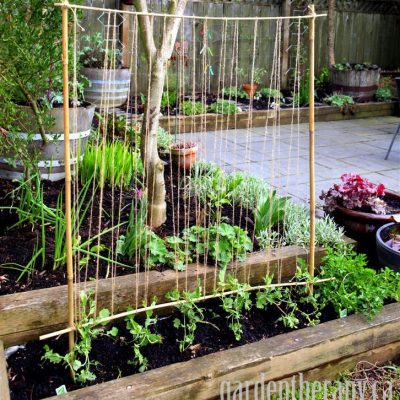
When you plant your peas they will start to ramble and tangle along the ground and the sweet tips get munched on by just about any vegetable loving creature you can imagine (slugs, snails, the darn dog!) so it’s nice to grow them vertically up a support. The little vines cling and twine nicely around string, and this simple trellis is perfect to pack a lot of peas into a small area.
Materials:
- Bamboo poles of various lengths
- A spool of garden twine
- A garden helper
Directions:
1. Stick two 6’ or longer bamboo poles into the soil on either side of your pea patch.
2. Make a frame using two more bamboo poles that measure a few inches longer than the width of your side stakes. Secure the poles together by tying twine around the poles where they cross in a figure eight pattern.
Seed Starting Containers: The Real Dirt – Part 2
This the fourth post in the Seed Starting Series. Please have a read of the other posts starting with Seed Starting 101 for the basics, Seed Starting Containers: The Real Dirt – Part 1 for many ideas on making your own homemade containers, and Seed Starting with Mini Greenhouses on how to get outdoor seeds a great start earlier.
Part 2 of Seed Starting Containers: The Real Dirt checks out the pros and cons of store-bought seed starters from your garden center or supply store. Just like the homemade containers, there are many different options for starting seeds with purchased containers but not all of them will give your seedlings the best start. The prices range from frugal to just plain silly. Expensive doesn’t always mean best. Please have a read through this list of pros and cans so you can sort out the gimmicks from the goods.
Peat Pellets
These little pressed peat pellets are sold in small disks covered by thin netting. When soaked in water they grow to 3-5x in size and have a little hole in the top for the seed to go in. They are often sold in mini greenhouse kits with a black watering tray and clear plastic greenhouse dome. With these pellets you are growing a plug which is meant to be potted up to a larger pot or in the ground quite soon after the seedling sprouts.
Pros: fairly cheap if bought in bulk (but watch out for high prices in some shops), compact to store, fits nicely in seed starting trays (in many cases you can fit 72 plugs per tray), netting can carefully be removed providing a protected soil plug that can be carefully potted into a larger pot or the garden
Cons: too small to be useful for most seedlings, the netting should really be removed as to not stress the roots when they are tiny (technically roots can grow through the net, but in my experience the plants are smaller as the net restricts normal root growth), re-potting when seedlings are that small is unnecessarily stressful to the plant and they are easily damaged
Please note that peat moss is a controversial product. Some reports say that peat bogs are being over harvested and other reports show otherwise. For more information please check out Peat Moss and The Environment and The Myth of Permanent Peatlands.
Peat or Coir Pots
Pots made of pressed peat or coconut coir (fiber) that you still fill with soil before planting your seeds are becoming increasingly popular plus they on-trend with a push towards green, biodegradable products. The claim is that the roots can grow through the pot so they can be planted directly out in the garden. You should rip the top of the pot off to soil level when planting out however, because if the edges of the pot sit above the soil line, it will wick moisture away from the roots.
Pros: Large enough that you don’t need to repot the seedling right away, more sustainable than plastic (but see note on peat moss above)
Cons: EXPENSIVE, gimmicky, gives roots unnecessary struggle to get through pot to reach garden soil (some manufacturers call this “root-pruning” but I still find the plants are much smaller and less healthy than those without the root ball surrounded by a biodegradable pot
Plastic Pots
There is a wide array of plastic pots available for seed starting. You can use the nursery pots that you or your gardening friends will no doubt have stacked up somewhere from buying brand-sparkly-new plants. You can also buy a whole array of sizes and shapes for setting in black plastic trays. In general, bigger pots are best for bigger plants and plants that are delicate (that you don’t want to transplant too many times). Smaller pots sometimes come in multiples like 6 or 9, can be used for growing smaller plants, plugs of multiples (like lettuce and peas), or for seedlings that will move out to the garden in a very short time (like beans).
Square tall plastic nursery pots are my favourite way to start plants. I like that they have a deeper soil base, are large enough that you don’t need to pot-up seedlings before transplanting in the garden, and the square shape efficiently fits into black plastic trays. I also like plastic containers with 6 separate sections for growing many of one kind of plant.
Now, while plastic is not sustainable or biodegradable, I use the same pots year after year, washing them out at the beginning and end of the season. Some I have purchased but many I’ve just acquired so the cost is very low. I do replace my black plastic trays every few years when I can’t patch up the holes. I have found a place to recycle them though, so I feel a bit better about that.
Pros: cheap to free, reusable, variety of sizes, best possible start for plants in my opinion.
Cons: not biodegradable, not cute or trendy
Mini Greenhouse Trays
The peat pellets, fiber pots, and plastic cells can be bought in pre-made mini greenhouse kits that include a black plastic bottom tray with some grooves to drain off the water and a clear plastic dome to act as a greenhouse, which prevents soil from drying out and maintains humidity. You must remove the dome after the seeds sprout as too much humidity can lead to “dampening off”, a fungal disease that will kill the new seedlings. I have a set of these from when I was a seed-starting beginner and I use them year after year. They are a great investment and an essential seed starting tool for me.
Pros: neat, convenient, good system for germinating seeds, reusable
Cons: you will have to buy a larger dome if you want to keep using it past the sprouting stage as seedlings will quickly outgrow the lid, dome only useful for germination (after that high-humidity causes fungal disease)
Self-Watering Trays
If you are a forgetful gardener, or plan to be away when you’ve started your seeds, then a self-watering tray is a good option. The pots sit on a fiber pad that wicks water up from a reservoir below. You must soak the pad and ensure that the reservoir is full then the soil sucks up moisture from the pad when it’s needed. I have some and they stay very moist which is good for seedlings AND fungus. One thing to watch out for is mold growth or fungal disease starting on the wick. Keep the wick clean, washing occasionally and spray with a bit of hydrogen peroxide to kill fungus.
Pros: low maintenance, prevents seedlings from drying out
Cons: expensive to buy, promotes fungal growth
Heat Mats
Some greenhouse kits come with an electric heat mat that sits below the plastic tray. These can also be purchased separately. Heat mats claim to aid in germination by raising the soil to the optimum temperature. Some people use heating pads (that you would use for your back) but the temperatures are much higher on those so proceed with caution, you could easily cook your soil and seeds.
I always use heat mats for my tomatoes, it helps them germinate in just a few days as opposed to weeks and gets them off to a better start. Use the heat mat during the day and turn it off at night to simulate the natural cooling of the soil at nighttime. Remove the heat mat as soon as all the seeds have germinated and set them up with some grow lights instead.
Here is a photo of my set up, that include plastic pots in mini greenhouse trays (tomatoes, peppers, cucumbers, kale, tarragon, cilantro, spinach, radicchio) and some green self watering pots with individual greenhouse domes (different lettuce varieties and oriental greens).
For more information on the whole process of seed starting, check out Seed Starting 101 for a birds eye view of what’s required to start seeds.
Stay tuned for the next post in this series, Growing Seedlings Indoors, which will have instructions to build a DIY grow light set up like this:
Buying Guide
Spring Garden Tool Care and DIY Storage Bin
Cleaning and organizing the garden tools may not be the most glamorous job, but it certainly gets the gardening year off on the right flip flop. Plus, I discovered a handy new way to organize my small garden tools and that’s pretty darn exciting (if you disagree with me now, just wait until mid summer when you have a hundred things to prune and you can easily find clean, sharp snips in no time at all – yeah, that’s exciting).
I’ve read in a few places that a great way to store your tools is in a bin filled with sand and a little oil. Last summer I decided to give this a try. They ‘recipe’ recommend adding coarse sand to some sort of bucket and adding motor oil. I didn’t want to use motor oil as I was worried about the adverse affects on my organic garden, and I thought vegetable oil would go rancid, so I left out the oil and just oiled my tools regularly.
The benefit of this method is that your tools are easy to grab and easily kept organized. The drawback is that the sand really mucks up your tools, particularly the pruners. It gets into all the crevices and it just doesn’t work for me. I do not recommend storing your tools in sand but if you have a way that it works for you, please let me know.
Since I liked the organization I got with my small tools, I decided to replace the sand with river stones. This works beautifully! Fill up 1/3 of a shallow but wide bin with round river stones and insert tools. It holds them in place so you can find them easily, it takes up very little room, and it’s simple to maintain.

It’s also a good idea to wash and sharpen your tools regularly. Many gardeners will wash, oil, and sharpen pruners before each gardening day. Others may do it more often (i.e.: between plants which is always a good idea if there are disease issues that can be spread), and some do it less often (one a week, a month, never.) Keeping tools clean and sharp will ensure they perform as you wish, last a long time, and don’t spread disease.
I try to keep my tools clean and sharp but it’s not a perfect system. I work best with scheduled activities so in both the spring and fall I like to follow this hand tool maintenance program:
Terrarium Craft Review & Salad Bowl Terrarium Project
I was so excited to get a review copy of Terrarium Craft: Create 50 Magical, Miniature Worlds , probably more excited than is considered ‘normal’. Flipping through the 50 projects, there was clearly lots of inspiration. After a brief introduction on materials and techniques, Terrarium Craft stunning photography showcases forest, beach, desert, and fantasy terrarium ideas.
After reading the book cover to cover, I was so inspired to try some projects I have all but put my seed starting on hold and transformed my corner window grow-op into a terrarium building site. Air plants, succulents, shells, rock and found objects abound as terrariums are a nature lover’s doll house. For my first project I fashioned a woodland-inspired terrarium out of a salad bowl, moss, Aeonium, Sedum, Bromeliad and a tiny felted owl.
Materials:
- Glass salad bowl
- Indoor cactus soil
- Polished river stones
- Branches, lichen, found objects
Plants:
- Aeonium
- Sedum
- Bromeliad
- Spanish Moss (epiphyte)
- True Moss (bryophyte)
Instructions:

1. Fill the bottom 1/3 with cactus soil (note: the book suggests using sand or moss balls to plant your terrarium, but I don’t mind the look of soil and I’m not worried about drainage because I’ll carefully. The book’s projects do look cleaner with the sand so it’s all personal preference).
2. Place true moss around one side of the bowl. Shake soil gently off the root ball of the aeonium, sedum and bromilad. Dig little holes in the cactus soil and place plants. Back fill with soil and place moss around plants on the moss side. Add some river stones to the other half to cover the soil up to the moss level.
3. Add fun personal elements that will add personality to your “mixed salad”. Shown here are Spanish moss (which is a type of Tillandsia or air plant so it should float above the soil), a twig with bird’s nest mushrooms I collected back in the mushroom foraging days of autumn, and a felted pocket owl that I bought from Etsy which has it’s own story.
The final result is a quirky terrarium that reminds me of days waking thought the woods with the dogs, hoping to spot a real owl like these, and collecting gems from the forest floor.
There are a few other projects that I’d like to try from the book, like suspending plant roots in a moss ball inside the terrarium, but for now I best get on my seed starting or I’ll be very sad and/or broke come heirloom tomato season.
If you have tried a terrarium, or plan to try one, please let me know. I would love to see photos of this very personal art form.
DIY Summer Blooms Garden Apron
This cheery garden apron combines the functionality to keep your tools and supplies close at hand while adding a bright lift to early spring days. The vibrant bright pattern will be right at home in the summer but for now–as spring arrives–it provides inspiration for a summer filled with gorgeous blooms.
This apron has large, deep pockets so you can fill them with seed packets, plant labels, and various tools. It is quite wide, so that you can fill the side pockets with all sorts of stuff, and still bend over to dig without getting stabbed in the belly by a weeding fork (!). I also made a loop to hold my pruners off to the side so I can draw them quickly when encountering a showdown with unruly branches. I like my ties to be extra long so they tie in the front with lots room to make a pretty bow.
Here’s how to make your own.
Materials:
Sturdy weight fabric – plain for apron back, pattern for pockets, waistband, and sash cut as follows:
- 1 – 20” x 14 plain colour fabric for apron back
- 1 – 23” x 10” patterned fabric for apron pockets
- 1 – 20” x 4” patterned fabric for waist band
- 2 – 42” x 4” patterned fabric for long, wraparound sashes
Directions:
1. Cut all fabric to the dimensions listed to make a ladies’ large apron. Adjust size up or down to fit. Hem the two short sides of the back fabric, the top and bottom won’t matter, and hem the top edge of the pocket. Using a glass, cut rounded corner on the bottom corners of both the back fabric and the pocket fabric.
2. Lay the larger pocket cut of fabric on the back fabric, and pin 3 pleats along the bottom edge so that the pocket fabric now is the same width as the back. Sew pleats with a double stitch about 1 ½” up from the bottom.
3. Place the back fabric with hem facing upward, and then lay the pocket fabric facing downward on top. Pin and sew along the side and bottom edges. Turn right side out and make a decorative stitch along the sides and bottom of the apron. Sew two straight lines to create the pocket dividers.
4. To make the sashes, fold the fabric strips in half lengthwise and inside out. Sew the two long ends together making a long tube. Turn tube right side out with a chopstick and some patience. Fold the ends of the sashes inward and stitch to finish the ends.
5. Sew each sash to the top sides of the waistband. Iron the waistband in half, and then fold over each end by ¼”. Fold waist band over the top edge of the back fabric and covering the two sides where the sashes are attached. Sew along the bottom and sides to secure and along the top edge for continuity.
6. Make a loop to hold pruners or other tools by folding a 2” x 5” long cut of fabric lengthwise and folding the edges in. Sew top bottom and sides to secure the “ribbon”. Attach to apron back by sewing the right end to the apron back, then sewing the same end 1” to the right. Loop the ribbon around to the other side, sew the left end near the right end, and then again sew 1” to the left of the third line.
Thanks for visiting for the weekend project!
Painted Mason Jar Planters + Shamrocks
Purple and green Oxalis planted in painted mason jars make a modern arrangement for this St. Patrick’s Day.
St. Patrick’s Day typically reminds folks of leprechauns, green beer, Ireland, and shamrocks: the symbol seen on green-felt fedoras. But I’m a plant nerd so I think about the shamrock from a botanical point (and I try not to remember those nights drinking green beer). The symbol of Ireland is the three-leaf old white clover, Trifolium repens, which is common in North America and Europe in grassy areas as well as a pasture crop. I fondly remember summer days as a child searching for a lucky four-leaf clover lying in park grass. While many launch a year long fight to get clover out of their lawns, I’m happy to leave it blooming for the bees and give the lawn a rich green colour.
There are a few other three-leaf herbaceous plants that share the Shamrock moniker my favourite being Oxalis. Native to South America and Africa, this genus of over 500 species are often grown as ornamental plants in home gardens or as houseplants.
Oxalis in my garden in tucked in shady woodland areas where it generally hides from the camera. To get a few better shots and really enjoy the beauty of the plant, I picked up a few from the garden centre to use in my spring arrangements.
Oxalis regnellii is typically grown in this zone (7-8) as a houseplant due to its vulnerability to frost. Pale lavender to white flowers bloom regularly on healthy plants given plenty of light but away from direct sunlight.
With Oxalis regnellii ‘Atropurpurea’, the blooms are hardly worth considering when compared to the dark eggplant foliage, often with brighter purple centre leaf margins.
Inspired by the colour palette provided by the two false shamrocks, I created a St. Patty’s day floral arrangement using painted mason jars as planters and as a case for some deep purple tulips.
Painted Mason Jar Tutorial
Materials:
- Mason jar(s)
- Latex house paint
- Craft paint
- Foam paint brush
- Flowers / plants
Directions:
This is a simple project that I have seen done with spray paint. I chose to tint some leftover latex trim paint as : a) I had some, b) I wasn’t keen on the fumes from the spray, and c) I wanted more control over the colour.
Simply mix up the colour that you want by added craft paint into the latex pain in a yogurt container. Mix really well then pour a little into your mason jar. Use the brush to paint the inside evenly and leave to dry. Apply a second coat if necessary. One coat is shown here.
To make into a planter, fit a plastic nursery container containing your plant onto the top. Ensure there is a little lip holding it on the edge so you can remove it when necessary.
To make a vase, insert a thin glass vase into the painted jar.
Choosing interesting shapes and patterned jars will add even more interest to the project. I like the simplicity of them on my fireplace mantle where they contrast with the painting.
It has also been quite fun to watch the Oxalis “go to sleep” at night, or rather the leaves droop down as a result of nyctinasty, a plant’s chemical response to the onset of darkness that causes the leaves to tuck in for the night. It gives these guys a bit of personality which may leave you unconsciously whispering at night as to not disturb them.
Thanks for visiting this weekend’s project which will be added to these link ups.